
Hindi Typing Test
Take a timed typing test to evaluate your WPM speed, accuracy, and error counts.
SSC Typing Test Guidelines
SSC Hindi Typing requires 30 WPM (using InScript or Remington layouts) with up to 5-7% error tolerance depending on candidate category.
Typing Test Job Preparation in India: A Complete Guide for SSC UDC, LDC, Clerk, Stenography and Assistant Jobs
Typing skills have become an essential requirement for many government and private-sector jobs in India. While competitive examinations often focus heavily on subjects such as General Knowledge, Reasoning, Mathematics and English, candidates sometimes underestimate the importance of the typing test. As a result, many candidates successfully clear written examinations but struggle during the typing or skill test.
Jobs such as Lower Division Clerk (LDC), Upper Division Clerk (UDC), Junior Clerk, Data Entry Operator (DEO), Stenographer, Assistant and several other clerical and administrative positions require candidates to possess good typing skills. Depending on the recruitment organization and post, candidates may need to type in English, Hindi or both. They may also be tested on typing speed, accuracy, formatting and computer proficiency.
This guide explains everything candidates need to know about preparing for typing tests in India, including typing speed requirements, practice methods, accuracy improvement, keyboard familiarity, common mistakes and strategies for government job typing examinations.

Understanding Typing Tests for Government Jobs
A typing test is designed to evaluate how efficiently a candidate can enter information using a computer keyboard. Unlike a written examination, a typing test measures practical skills. The candidate is usually given a passage or text and asked to type it within a specified time.
The final evaluation may depend on several factors, including:
- Typing speed
- Typing accuracy
- Number of mistakes
- Words typed correctly
- Characters typed per minute
- Formatting accuracy
- Completion of the required passage
- Ability to type under time pressure
Different government organizations follow different rules. Therefore, candidates should always carefully read the official notification for the specific recruitment they are preparing for.
In many cases, the typing test is qualifying in nature. This means the marks obtained may not be added to the final merit score, but candidates must meet the minimum required typing standard to remain eligible for selection.
However, candidates should never assume that a qualifying typing test is unimportant. Failing the typing test can result in disqualification even after successfully clearing multiple stages of a competitive examination.
Jobs in India That Require Typing Skills
Typing skills are required for a wide variety of jobs in India. Some of the most common positions include clerical, administrative and data-entry roles.
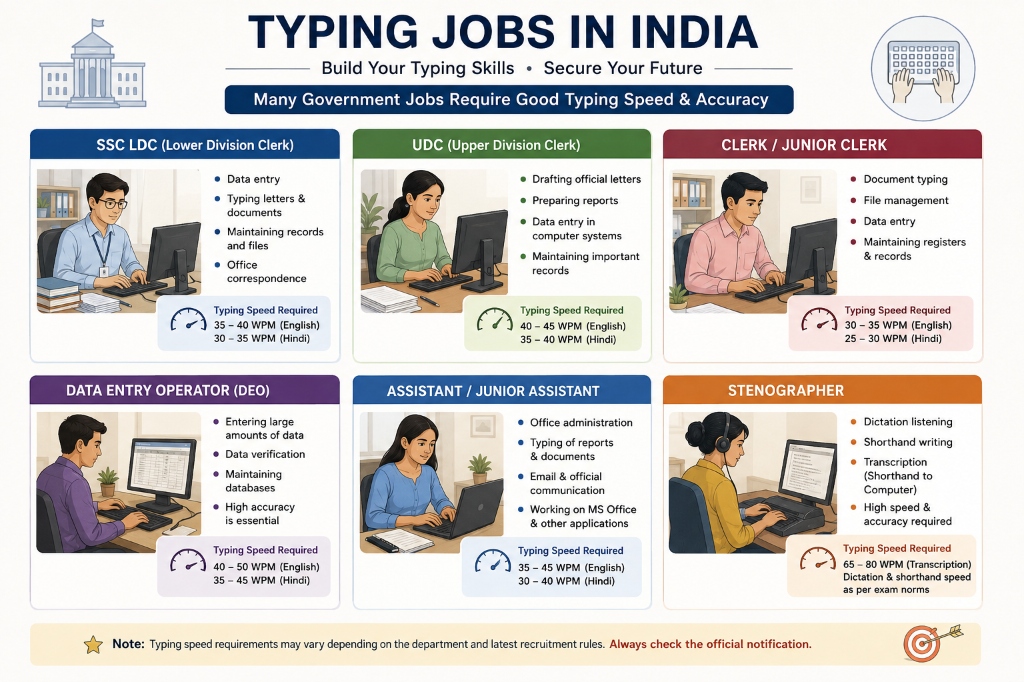
SSC LDC and Clerical Posts
Lower Division Clerk positions generally involve office administration, document preparation, data entry, maintaining records and official correspondence.
Candidates may need to:
- Type official letters
- Prepare documents
- Enter data
- Maintain digital records
- Draft reports
- Handle office correspondence
Good typing speed and accuracy can therefore be essential for performing the job effectively.
UDC and Upper Division Clerk Jobs
Upper Division Clerk positions generally involve more administrative responsibility compared with entry-level clerical jobs. Depending on the organization, candidates may be required to work extensively with documents, files and computer systems.
Strong keyboard skills help candidates perform tasks such as preparing official correspondence, entering information into databases and maintaining records.
Junior Clerk and Clerk Jobs
Many state government departments, courts, banks and other organizations recruit Junior Clerks or Clerks. Typing tests are common during recruitment for these positions.
Candidates may be tested in English, Hindi or the language specified by the recruitment authority.
Data Entry Operator Jobs
Data Entry Operator positions naturally require strong keyboard skills. Candidates may be required to enter large amounts of information accurately and quickly.
These tests may focus on:
- Speed
- Accuracy
- Data-entry efficiency
- Characters per hour
- Key depressions
- Numerical data entry
A candidate who types quickly but makes frequent mistakes may struggle to qualify.
Assistant and Administrative Jobs
Several government departments recruit Assistants, Junior Assistants and administrative personnel. Computer proficiency and typing ability may be included in the selection process.
These jobs often involve preparing official documents, emails, reports and digital records.
Stenographer Jobs
Stenography jobs require a different set of skills. Candidates must first transcribe spoken content using shorthand and may then need to type or transcribe the dictated material using a computer.
Stenographer examinations can therefore require:
- Shorthand speed
- Dictation ability
- Transcription speed
- Typing accuracy
- Strong language knowledge
Stenography requires dedicated practice because candidates must listen, understand, record and transcribe information efficiently.
Why Typing Accuracy Is More Important Than Candidates Think
Many beginners focus entirely on increasing typing speed. They constantly check their words-per-minute score and try to type faster.
However, speed without accuracy can become a serious problem.
For example, imagine two candidates:
Candidate A types at 50 words per minute but makes many mistakes.
Candidate B types at 40 words per minute with excellent accuracy.
Depending on the examination rules, Candidate B may perform significantly better because incorrect words can reduce the effective typing speed.
A good typing test strategy should therefore focus on both speed and accuracy.
Candidates should initially aim for approximately 95% or higher accuracy. As keyboard familiarity improves, speed will naturally increase.
Trying to type extremely fast before developing proper technique often creates bad habits. Candidates may repeatedly press incorrect keys, depend excessively on the Backspace key or constantly look at the keyboard.
The best approach is to first develop accuracy and proper finger placement and then gradually increase speed.
Understanding Typing Speed
Typing speed is usually measured in words per minute, commonly known as WPM.
A standard word for typing calculations may be based on a fixed number of characters depending on the examination or typing platform. Therefore, candidates should always understand the exact evaluation method used for their particular recruitment examination.
Typing speed requirements vary significantly between examinations.
Candidates should carefully check:
- Required words per minute
- Required key depressions per hour
- Duration of the typing test
- Language of the test
- Keyboard layout
- Error limits
- Whether the test is qualifying
- Whether marks are included in the merit list
Never prepare solely based on information from another examination. Recruitment rules can change, and different organizations may follow completely different standards.
Learning Proper Keyboard Position
One of the most important steps in improving typing ability is learning proper keyboard positioning.
Touch typing means typing without continuously looking at the keyboard.
The basic starting point is usually known as the home row.
For English typing, the fingers are generally placed around the central keyboard keys so that each finger develops responsibility for particular keys.
Proper finger positioning helps create muscle memory. Over time, the brain begins to remember where keys are located, allowing candidates to type faster without searching for each letter.
Beginners should avoid typing with only two fingers.
Two-finger typing may initially feel comfortable, especially for candidates who frequently use smartphones or computers casually. However, it can limit speed and create difficulties during longer typing tests.
Learning proper finger placement may initially reduce speed, but it provides significant long-term benefits.
The Importance of Touch Typing
Touch typing is one of the best skills a competitive exam candidate can develop.
A touch typist does not need to repeatedly look at the keyboard. Instead, the candidate looks primarily at the screen or source text.
This provides several advantages.
Better Speed
Candidates can type continuously without spending time searching for keys.
Better Accuracy
When the candidate focuses on the text rather than constantly moving their eyes between the keyboard and screen, errors can become easier to identify.
Less Fatigue
Proper typing technique reduces unnecessary hand movement.
Better Performance Under Pressure
During an examination, nervousness can make candidates forget keyboard positions. Strong muscle memory helps maintain consistent performance.
Developing touch typing takes time, so candidates should begin practicing well before their examination.
English Typing Preparation
English typing tests usually require candidates to type passages containing ordinary words, punctuation and numbers.
Candidates should practice different types of material, including:
- News articles
- Government-related passages
- Formal English
- General paragraphs
- Official-style letters
- Difficult vocabulary
- Numbers and dates
- Punctuation-heavy text
Practicing only simple sentences can create problems during the actual examination.
A real typing test may contain:
- Long words
- Capital letters
- Commas
- Full stops
- Quotation marks
- Parentheses
- Numbers
- Special symbols
Candidates should therefore become comfortable using the Shift key and punctuation keys.
Hindi Typing Preparation
Hindi typing requires additional preparation because candidates may need to use specific keyboard layouts or typing methods.
Depending on the examination, candidates should confirm whether the required method involves a particular layout.
Hindi typing candidates should focus on:
- Keyboard layout familiarity
- Matras
- संयुक्त अक्षर
- Correct spelling
- Proper spacing
- Special Hindi characters
Hindi typing speed can initially feel slower because candidates need to become familiar with the location of characters and symbols.
Regular practice is essential.
Candidates should avoid switching between multiple typing methods unnecessarily while preparing for a specific examination. They should practice using the exact method and layout required by the recruitment authority.
Stenography Preparation
Stenography is different from ordinary typing because it involves converting spoken language into written text.
A stenographer must develop several abilities simultaneously.
First, the candidate listens carefully to dictation.
Second, the candidate records the dictated material using shorthand.
Finally, the shorthand notes are transcribed accurately.
Stenography preparation should focus on:
- Shorthand fundamentals
- Speed-building exercises
- Dictation practice
- Listening ability
- Transcription practice
- Grammar
- Spelling
- Punctuation
Candidates should gradually increase dictation speed rather than immediately attempting extremely high speeds.
For example, beginners can start with slower dictation and focus on accuracy. Once they become comfortable, they can gradually increase speed.
Regular dictation practice is extremely important.
A Daily Typing Practice Routine
Candidates preparing for typing tests should maintain a regular practice schedule.
A beginner may start with approximately 30 to 60 minutes of daily practice. More experienced candidates can divide practice into multiple sessions.
A useful practice routine can include the following stages:
Warm-Up Practice
Spend a few minutes typing simple words and sentences. The purpose is to relax the fingers and develop rhythm.
Accuracy Practice
Practice slowly while focusing on typing every word correctly. Do not worry excessively about speed.
Speed Practice
Attempt timed typing tests. For example: 5-minute tests, 10-minute tests, or longer tests depending on examination requirements.
Error Analysis
Review mistakes carefully. Identify whether mistakes occur because of incorrect finger placement, difficult letters, capital letters, punctuation, numbers, or lack of concentration.
Final Timed Test
End the session with one realistic typing test. This helps candidates track progress.
How to Increase Typing Speed
Typing speed generally improves gradually through repetition and consistency. Candidates should avoid expecting dramatic improvement overnight.
The following methods can help increase speed:
- Practice Regularly: Typing for a short period every day is generally more effective than practicing for several hours only once a week.
- Avoid Looking at the Keyboard: This may initially feel difficult, but it is essential for developing touch typing.
- Learn Correct Finger Placement: Each finger should gradually become familiar with its assigned keys.
- Focus on Common Word Patterns: Frequently used words eventually become automatic.
- Practice Difficult Combinations: If certain key combinations repeatedly cause mistakes, practice them separately.
- Use Timed Tests: Timed tests help develop speed under examination conditions.
- Maintain a Comfortable Rhythm: Typing too aggressively can increase mistakes. A smooth and consistent rhythm is generally better than irregular bursts of speed.
How to Improve Typing Accuracy
Accuracy requires concentration and controlled movement. Candidates can improve accuracy by:
- Typing slightly slower during practice
- Maintaining proper posture
- Looking at the source text carefully
- Avoiding unnecessary rushing
- Practicing difficult words
- Reviewing repeated mistakes
- Taking short breaks when tired
Candidates should identify patterns in their mistakes. For example, if they frequently type "teh" instead of "the" or repeatedly miss punctuation, they should specifically practice those weaknesses. Targeted practice is often more effective than simply taking random typing tests repeatedly.
Common Typing Mistakes
Several mistakes commonly affect typing test performance:
- Looking at the Keyboard: Constantly looking down slows typing and makes it difficult to maintain concentration.
- Typing Too Fast: Trying to achieve maximum speed can result in excessive mistakes.
- Overusing Backspace: Frequent corrections interrupt typing rhythm. Candidates should understand the examination rules regarding corrections and errors.
- Poor Posture: Incorrect sitting position can cause discomfort and fatigue.
- Ignoring Punctuation: Candidates sometimes practice only letters and words but struggle with punctuation during actual tests.
- Practicing Only Easy Text: Real examinations may contain difficult vocabulary and formal language.
- Not Taking Full-Length Tests: Candidates may perform well during short practice sessions but struggle during longer examinations. Full-length practice is therefore essential.
Preparing Under Examination Conditions
As the typing test approaches, candidates should begin practicing under realistic conditions. Use the same or similar time duration, keyboard type, language settings, sitting posture, and examination environment.
Avoid pausing the timer unnecessarily. The goal is to train the mind to perform continuously under pressure. Candidates should also practice when slightly tired or distracted because examination conditions may not always feel comfortable. However, proper rest before the actual examination remains important.
Choosing the Right Keyboard
Candidates should become comfortable using a standard computer keyboard. Different keyboards may have slightly different key spacing, key height, key pressure, and layout design.
If possible, candidates should practice on a desktop-style keyboard similar to the one likely to be used during the examination. Laptop typing can feel different because laptop keyboards are usually more compact. Candidates should not depend entirely on a specific keyboard. They should develop enough adaptability to type comfortably on standard keyboards.
Improving Finger Strength and Comfort
Long typing sessions can cause hand fatigue, particularly for beginners. Candidates should maintain relaxed hands, avoid excessive force, sit comfortably, keep wrists in a natural position, and take short breaks during practice. Typing does not require pressing keys extremely hard. A light and controlled touch generally improves speed and reduces fatigue.
Mental Preparation for Typing Tests
Typing tests are not only about keyboard skills. Confidence and concentration are equally important. During the examination, candidates may become nervous because of the countdown timer, the importance of the examination, noise in the examination centre, or fear of making mistakes.
Candidates should avoid panicking after making a small error. One mistake does not mean the entire test is ruined. Continue typing calmly and maintain rhythm. A candidate who loses concentration after a mistake may make several additional mistakes. Practice should therefore include mental discipline.
A 30-Day Typing Improvement Plan
- Days 1 to 7: Focus primarily on keyboard familiarity, finger placement, accuracy, and basic words. Do not chase extremely high speed.
- Days 8 to 15: Begin timed typing tests, difficult words, numbers, punctuation, and longer paragraphs. Track both speed and accuracy.
- Days 16 to 23: Increase practice intensity. Attempt realistic examination-style typing tests. Focus specifically on repeated weaknesses.
- Days 24 to 30: Take regular full-length mock typing tests. Avoid experimenting with completely new typing methods at the last moment. Focus on consistency, confidence, and accuracy.
Importance of Consistency
Typing is a skill based heavily on repetition. A candidate practicing every day for one month can make significant improvement. However, candidates should understand that improvement may not always appear immediately. Some days, typing speed may decrease because of fatigue, stress, lack of sleep, or difficult practice material. Instead of worrying about a single poor result, track long-term improvement. The goal should be consistent performance.
Final Tips for SSC, Clerk, LDC, UDC and Assistant Candidates
- Always read the official notification carefully.
- Know the exact typing requirement for your post.
- Practice both speed and accuracy.
- Learn touch typing if possible.
- Practice using realistic passages.
- Become comfortable with punctuation and numbers.
- Take timed typing tests regularly.
- Analyse repeated mistakes.
- Practice on a standard computer keyboard.
- Maintain proper posture.
- Do not panic after small mistakes.
- Practice consistently until the examination.
Conclusion
Typing tests are an important part of recruitment for many jobs in India, including positions such as SSC LDC, UDC, Clerk, Junior Assistant, Data Entry Operator, Assistant and Stenographer. Many candidates make the mistake of focusing entirely on the written examination and beginning typing preparation only after clearing earlier stages. This can create unnecessary pressure and may result in disqualification during the skill test.
The best approach is to begin typing preparation early. Candidates should gradually develop keyboard familiarity, proper finger placement, touch typing ability, speed and accuracy. Instead of chasing extremely high typing speed from the beginning, candidates should first build a strong foundation. Regular practice, realistic mock tests and careful analysis of mistakes can significantly improve performance.
Whether you are preparing for an SSC clerical position, a government clerk job, an LDC or UDC post, an assistant position or a stenography examination, strong typing skills can become an important advantage. Remember that typing is a skill. Like any other skill, it improves through consistent and focused practice.
Start slowly, focus on accuracy, build speed gradually and practice under realistic examination conditions. With discipline and regular practice, candidates can significantly improve their typing performance and approach their typing test with confidence.