
SSC CHSL 2026 Notification: Apply Online for 10+2 Vacancies, Syllabus, Salary, and Exam Pattern
The Staff Selection Commission (SSC) has officially announced the Combined Higher Secondary Level (CHSL) Examination 2026, offering a golden opportunity for candidates who have completed their 10+2 education. The SSC CHSL is one of the most highly anticipated recruitment drives in India, opening doors to prestigious government jobs in various ministries, departments, and offices of the Government of India.
This massive 1500+ word guide will walk you through every critical aspect of the SSC CHSL 2026 recruitment. From a deep dive into the job profiles and day-to-day responsibilities to a comprehensive salary breakdown, career growth trajectory, and an in-depth syllabus analysis, we have covered everything you need to know to succeed in this examination.
1. Introduction to SSC CHSL 2026
The SSC CHSL exam is conducted annually to recruit eligible candidates for various posts such as Lower Division Clerk (LDC), Junior Secretariat Assistant (JSA), and Data Entry Operator (DEO). With thousands of vacancies expected this year, competition will be fierce. However, with the right strategy and a clear understanding of the exam pattern, cracking SSC CHSL 2026 is entirely achievable.
2. Overview of the Recruitment
Here is a quick glance at the SSC CHSL 2026 recruitment:
| Parameter | Details |
|---|---|
| Organization | Staff Selection Commission (SSC) |
| Exam Name | Combined Higher Secondary Level (CHSL) 10+2 |
| Posts | LDC, JSA, DEO, DEO Grade A |
| Vacancies | Expected around 4,500+ |
| Application Mode | Online |
| Selection Process | Tier 1 (CBT), Tier 2 (CBT + Skill Test) |
| Official Website | ssc.gov.in |
3. Important Dates and Deadlines
Candidates must keep track of the following crucial dates to avoid missing out on any important events:
- Notification Release Date: September 2026
- Online Application Start Date: September 2026
- Last Date to Apply: October 2026
- Last Date for Fee Payment: October 2026
- Tier 1 Exam Date: Expected in December 2026 / January 2027
4. Vacancy Details
While the exact number of vacancies will be updated in the final vacancy list released by SSC, it is anticipated that there will be over 4,500 vacancies distributed across various ministries, statutory bodies, and tribunals. The vacancies are generally divided among:
- Lower Division Clerk (LDC) / Junior Secretariat Assistant (JSA)
- Data Entry Operator (DEO)
5. Detailed Job Profile & Responsibilities
Understanding the day-to-day work associated with each post is crucial before you apply. The job profiles for the SSC CHSL posts are as follows:
Lower Division Clerk (LDC) / Junior Secretariat Assistant (JSA)
The LDC/JSA is the backbone of clerical work in government offices. Their day-to-day responsibilities include:- File Maintenance: Managing the workflow of files, opening new files, and maintaining the filing system.
- Data Entry: Entering crucial data into the computer systems of the respective departments.
- Drafting: Drafting official letters, notes, and memos under the guidance of senior officers.
- Record Keeping: Maintaining registers and records of the department.
Data Entry Operator (DEO)
The DEO primarily handles the IT and data management aspects. Their responsibilities include:- Typing and Data Entry: Rapid and accurate entry of data into the government databases.
- Database Management: Updating and maintaining records on the system.
- Report Generation: Generating daily/weekly reports based on the entered data.
- System Maintenance: Basic troubleshooting and maintenance of the computer systems they operate on.
6. Comprehensive Salary Breakdown & Allowances
One of the biggest attractions of the SSC CHSL recruitment is the lucrative salary package and the perks associated with central government jobs. The salary is governed by the 7th Pay Commission.
Pay Levels
- LDC/JSA: Pay Level 2 (Rs. 19,900 - Rs. 63,200)
- DEO: Pay Level 4 (Rs. 25,500 - Rs. 81,100) or Pay Level 5 (Rs. 29,200 - Rs. 92,300)
Detailed Breakdown for LDC/JSA (Pay Level 2)
- Basic Pay: Rs. 19,900
- Dearness Allowance (DA): Currently at 50% (Subject to revision) - Rs. 9,950
- House Rent Allowance (HRA): Varies by city category (X, Y, Z). For X cities (27%) - Rs. 5,400 (minimum)
- Transport Allowance (TA): Rs. 1,350 + DA on TA
- Gross Salary: Approximately Rs. 38,000 to Rs. 40,000 per month in X cities.
- Deductions: NPS (10% of Basic + DA), CGHS, CGEGIS.
- In-hand Salary: Approximately Rs. 33,000 to Rs. 35,000 per month.
Perks and Allowances
Apart from the salary, employees enjoy several benefits such as:- Medical facilities through CGHS.
- Paid leaves (Earned Leave, Casual Leave, Medical Leave).
- Leave Travel Concession (LTC).
- Pension benefits under the National Pension System (NPS).
7. Career Growth & Promotions Hierarchy
A job secured through SSC CHSL is not just a job; it is the beginning of a long and secure career.
Promotion Path for LDC/JSA
- Lower Division Clerk (LDC)
- Upper Division Clerk (UDC)
- Section Officer (SO)
- Under Secretary
Promotion Path for DEO
- Data Entry Operator Grade A
- Data Entry Operator Grade B
- Data Entry Operator Grade C
- Data Entry Operator Grade F (System Analyst)
8. Eligibility Criteria
Before applying, candidates must ensure they meet the stringent eligibility criteria set by the SSC.
9. Educational Qualification
Candidates must have passed their 12th Standard or equivalent examination from a recognized Board or University. For the post of DEO Grade 'A' in the Office of Comptroller and Auditor General of India (C&AG), Science stream with Mathematics as a subject is mandatory.10. Age Limit and Relaxations
- Minimum Age: 18 years
- Maximum Age: 27 years
Age Relaxations:
- SC/ST: 5 years
- OBC: 3 years
- PwD (Unreserved): 10 years
- PwD (OBC): 13 years
- PwD (SC/ST): 15 years
11. Nationality
A candidate must be either a citizen of India, a subject of Nepal, or a subject of Bhutan, provided they possess the necessary eligibility certificates issued by the Government of India.12. Application Process: Step-by-Step Guide
Applying for SSC CHSL 2026 requires careful attention to detail to avoid application rejection.
- Visit the official SSC website: ssc.gov.in.
- Register yourself using a valid Email ID and Mobile Number.
- Note down the Registration Number and Password generated.
- Log in and fill out the detailed application form.
- Upload scanned copies of a recent passport-size photograph and signature in the prescribed format.
- Pay the application fee.
- Submit the form and take a printout for future reference.
13. Application Fee Details
- General/OBC/EWS Male candidates: Rs. 100/-
- Women/SC/ST/PwD/Ex-servicemen candidates: Exempted from fee payment.
14. Exam Pattern: Tier 1 & Tier 2
The selection process is divided into two tiers.
Tier 1 (Computer Based Examination)
The Tier 1 exam consists of four sections, each with 25 questions carrying 50 marks. Total time allowed is 60 minutes.- English Language (Basic Knowledge)
- General Intelligence
- Quantitative Aptitude (Basic Arithmetic Skill)
- General Awareness
Tier 2 (Computer Based Examination & Skill Test)
Tier 2 is more comprehensive and includes:- Section I: Mathematical Abilities and Reasoning & General Intelligence.
- Section II: English Language & Comprehension and General Awareness.
- Section III: Computer Knowledge Test (Qualifying in nature).
- Skill Test/Typing Test: Conducted for the specific posts to assess the typing speed and data entry skills of the candidates.
15. In-depth Syllabus Analysis
To prepare effectively, you must understand the depths of the syllabus.
English Language
Focus on Spot the Error, Fill in the Blanks, Synonyms/Homonyms, Antonyms, Spellings, Idioms & Phrases, One word substitution, Improvement of Sentences, Active/Passive Voice, and Reading Comprehension.General Intelligence (Reasoning)
The syllabus covers both verbal and non-verbal reasoning. Key topics include Semantic Analogy, Symbolic operations, Symbolic/Number Analogy, Trends, Figural Analogy, Space Orientation, Venn Diagrams, and Coding-Decoding.Quantitative Aptitude
- Number Systems: Computation of Whole Number, Decimal and Fractions, Relationship between numbers.
- Fundamental arithmetical operations: Percentages, Ratio and Proportion, Square roots, Averages, Interest, Profit and Loss, Discount, Time and distance, Time and work.
- Algebra: Basic algebraic identities.
- Geometry: Familiarity with elementary geometric figures and facts.
- Mensuration: Triangle, Quadrilaterals, Regular Polygons, Circle, Right Prism, Right Circular Cone, Right Circular Cylinder, Sphere.
- Trigonometry: Trigonometry, Trigonometric ratios, Complementary angles.
- Statistical Charts: Use of Tables and Graphs, Histogram, Frequency polygon, Bar-diagram, Pie-chart.
General Awareness
Questions are designed to test the candidate’s general awareness of the environment around them. Focus heavily on Current Affairs (last 6-8 months), Indian History, Culture, Geography, Economic Scene, General policy, and scientific research.16. Preparation Strategy
To crack the SSC CHSL 2026, a structured preparation strategy is paramount.
- Understand the Exam Pattern: Familiarize yourself completely with the Tier 1 and Tier 2 patterns.
- Create a Study Plan: Dedicate 6-8 hours daily. Allocate specific time slots for each subject based on your strengths and weaknesses.
- Focus on Basics: Clear your fundamental concepts, especially in Quantitative Aptitude and English Grammar.
- Mock Tests: Take at least two full-length mock tests every week. Analyze your performance to identify weak areas.
- Time Management: During practice, strictly adhere to the 60-minute time limit for Tier 1.
- Current Affairs: Read a standard newspaper daily (e.g., The Hindu or Indian Express) and follow monthly current affairs magazines.
17. Recommended Books for SSC CHSL
Choosing the right study material can make a huge difference.
- English: 'Objective General English' by SP Bakshi, 'Word Power Made Easy' by Norman Lewis.
- Quantitative Aptitude: 'Quantitative Aptitude for Competitive Examinations' by RS Aggarwal, 'Advance Maths' by Rakesh Yadav.
- Reasoning: 'A Modern Approach to Verbal & Non-Verbal Reasoning' by RS Aggarwal.
- General Awareness: 'Lucent’s General Knowledge', Manorama Yearbook.
18. Previous Year Cut-off Trends
Analyzing past cut-offs helps in setting a target score. For the unreserved (UR) category, the Tier 1 cut-off has typically ranged between 140 to 155 marks out of 200 in recent years. This high cut-off indicates the intense competition and the necessity to aim for at least 160+ to be in the safe zone.
19. Exam Difficulty Level
Historically, the SSC CHSL Tier 1 exam is considered to be of easy to moderate difficulty. The Quantitative Aptitude section can sometimes be calculative, while the English section tests basic grammar and vocabulary. The General Awareness section is often unpredictable and requires broad reading.
20. Skill Test / Typing Test Details
The final hurdle is the skill test.
- For DEO: Data Entry Speed of 8,000 Key Depressions per hour on Computer. For DEO in C&AG, a speed of 15,000 Key Depressions per hour is required.
- For LDC/JSA: Typing speed of 35 words per minute in English or 30 words per minute in Hindi on computer.
21. Document Verification Process
After clearing all tiers, candidates are called for Document Verification. You must carry:
- 10th and 12th Marksheets and Certificates.
- Category Certificate (if applicable).
- PwD Certificate (if applicable).
- Valid Photo ID Proof.
22. Conclusion & Final Tips
The SSC CHSL 2026 is a stellar opportunity for 12th pass candidates to secure a central government job. The journey requires dedication, consistent hard work, and smart preparation. Stay focused, practice relentlessly, and you will surely find your name in the final merit list. All the best to all aspirants!
Prepare & Test Your Speed on TypeHindi
Practice full 10-minute exam simulations for SSC CHSL, High Courts, and state clerical exams with real WPM & accuracy scoring.
Mandated by SSC for Hindi typing tests. Practice with official Unicode InScript layout and realistic passages.
Step-by-step interactive lessons for beginners. Master finger positions on home row, top row, and bottom row.
Interactive visual map of all vowels, consonants, halants, and special conjunct characters in Devanagari script.
Build muscle memory and reflex speed while destroying falling words in Hindi and English.
Interactive steno stroke teacher, vector animated demonstrations, word builder, and 40–120 WPM audio dictations.
Related Articles & Typing Guides
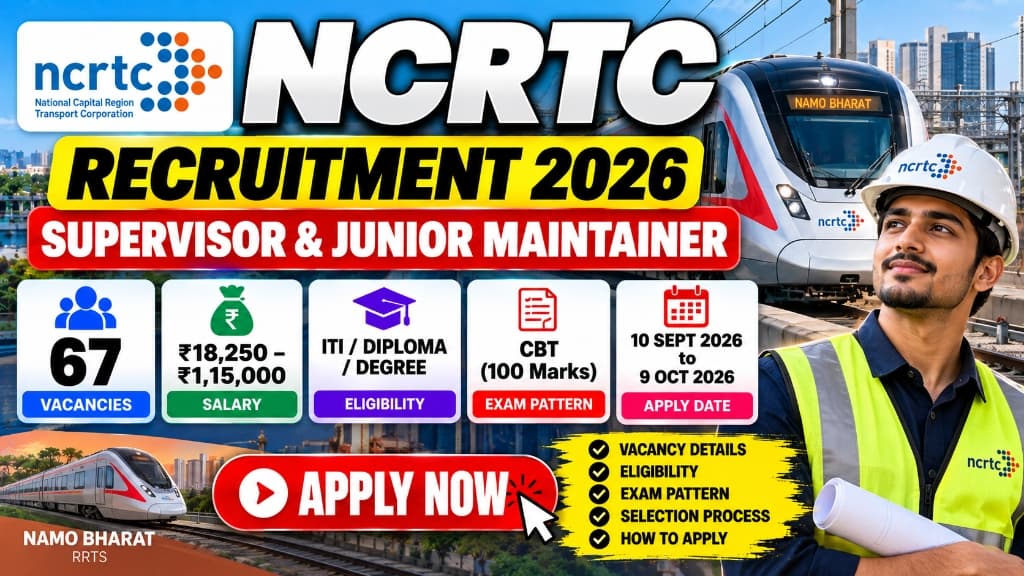
NCRTC Recruitment 2026: 67 Vacancies for Supervisor and Junior Maintainer Posts, Eligibility, Salary, Exam Pattern and How to Apply
The National Capital Region Transport Corporation (NCRTC) has released Vacancy Notice No. 32/2026 for the direct recruitment of Operations & Maintenance staff for the Namo Bharat/RRTS system.
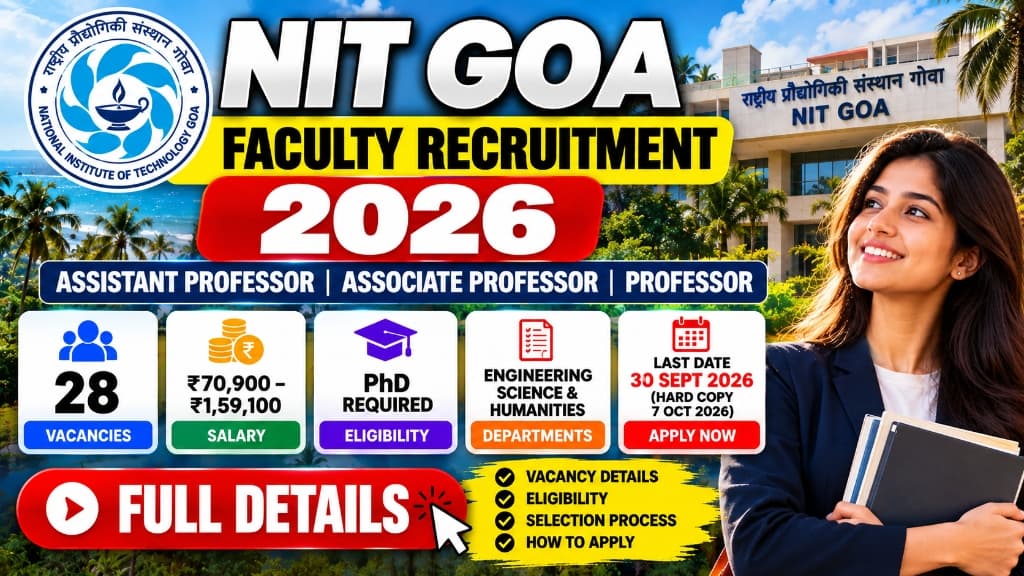
NIT Goa Faculty Recruitment 2026: 28 Posts, Eligibility, Salary, Vacancy, Selection Process and How to Apply
The National Institute of Technology Goa (NIT Goa) has released a notification for the recruitment of faculty members for various departments.
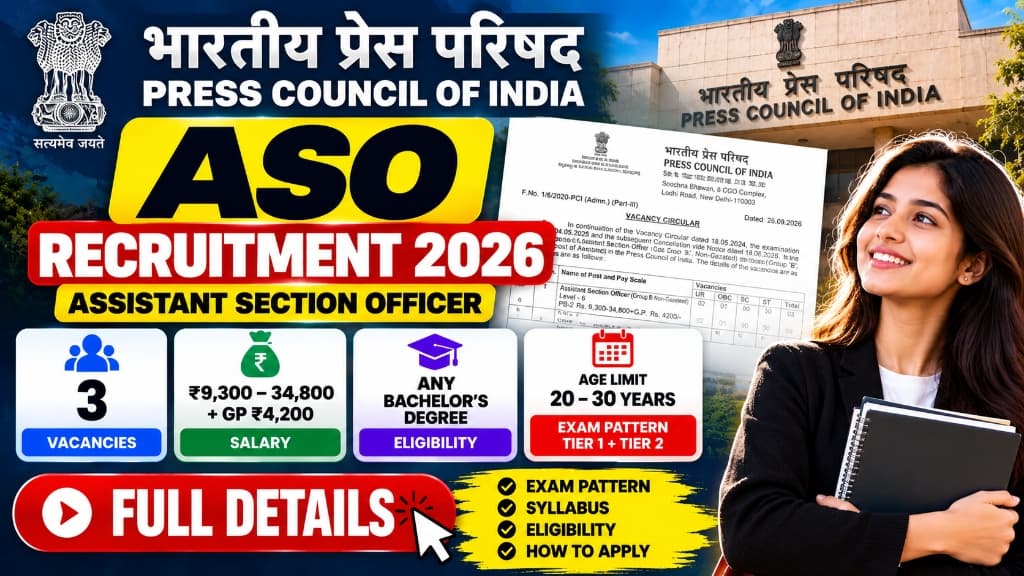
Press Council of India ASO Recruitment 2026: 3 Vacancies, Eligibility, Salary, Exam Pattern, Syllabus and How to Apply
The Press Council of India (PCI) has released a fresh Vacancy Circular 2026 for recruitment to the post of Assistant Section Officer (ASO).
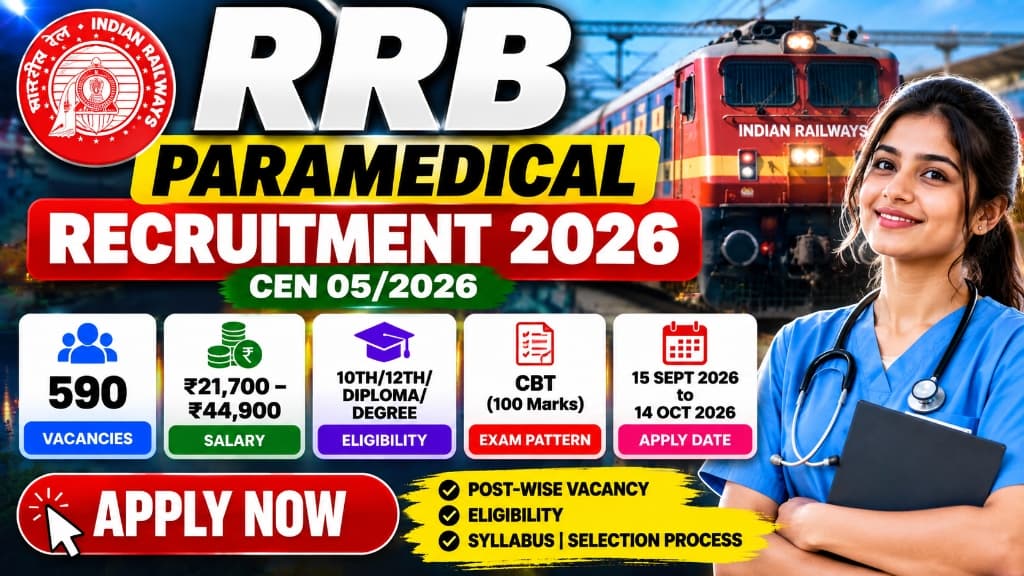
RRB Paramedical Recruitment 2026: 590 Vacancies, Eligibility, Salary, Exam Pattern, Selection Process and How to Apply
The Railway Recruitment Boards (RRBs) have released the RRB Paramedical Recruitment 2026 notification for 590 vacancies. Apply online till 14 October 2026.