
SSC CHSL Recruitment 2026: How to Pass the Typing Test
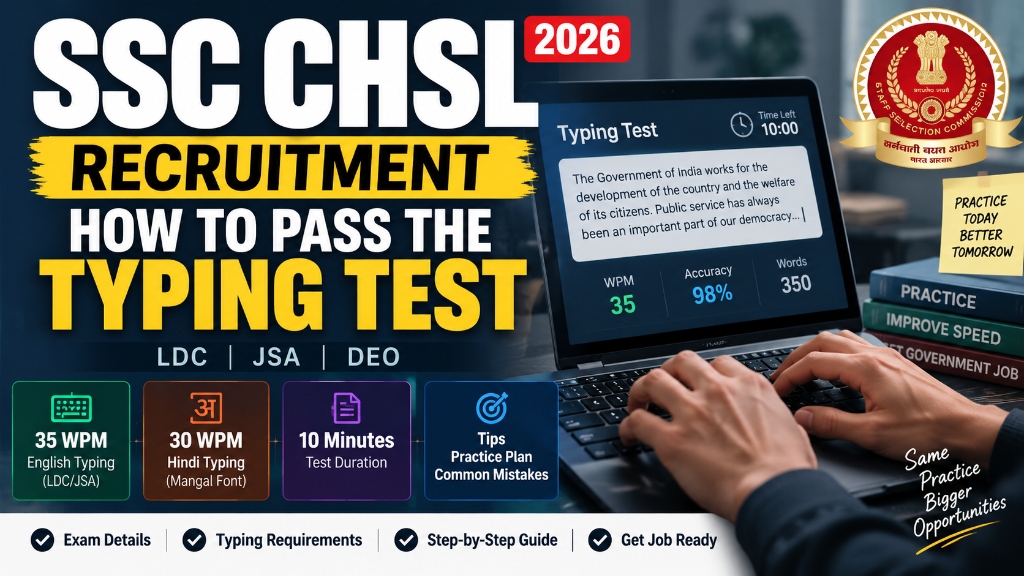
The SSC Combined Higher Secondary (10+2) Level Examination, or SSC CHSL 2026, is one of the most important government examinations for candidates looking for LDC, JSA and Data Entry Operator jobs. The 2026 notification has been issued by the Staff Selection Commission, with online applications scheduled from 7 September 2026 to 7 October 2026. The examination includes posts such as Lower Divisional Clerk (LDC), Junior Secretariat Assistant (JSA), Data Entry Operator (DEO) and Data Entry Operator Grade A.
For typing aspirants, SSC CHSL is particularly important because Tier-II contains a dedicated Skill Test/Typing Test. LDC and JSA candidates have to qualify in a computer-based typing test, while DEO candidates have a separate data-entry skill test with key-depression requirements.
The good news is that the CHSL typing test is not something you need to fear. With the right practice method, a candidate can improve both speed and accuracy systematically.
This guide explains exactly what the typing test involves, what speed you need, what happens during the test, how Hindi and English typing differ, how Mangal font works, how to practice, what mistakes candidates commonly make and how to build a preparation plan that actually works.
---
# SSC CHSL 2026: Quick Overview
| Particular | Details |
|---|---|
| Examination | SSC CHSL 2026 |
| Main Posts | LDC, JSA, DEO, DEO Grade A |
| Qualification | 12th Pass |
| Application Dates | 7 September to 7 October 2026 |
| Last Time to Apply | 7 October 2026, 11:00 PM |
| Tier-I | Computer Based Examination |
| Tier-II | Computer Based Examination |
| Typing Test for LDC/JSA | Yes |
| English Typing Speed | 35 WPM |
| Hindi Typing Speed | 30 WPM |
| Typing Test Duration | 10 Minutes |
| Hindi Font | Mangal |
| DEO Skill Test | Yes |
| Typing/Skill Test Nature | Qualifying |
The examination has two computer-based tiers. Tier-II contains four sections, with Section IV specifically dedicated to the Skill Test/Typing Test.
---
# Is There a Typing Test in SSC CHSL 2026?
Yes.
Candidates applying for LDC/JSA have to appear for the Typing Test in Tier-II.
Candidates applying for DEO and DEO Grade A appear for a Skill Test rather than the LDC/JSA typing test.
The typing or skill test is conducted in Session-II of Tier-II on the same day after the earlier sections of Tier-II are completed. The Skill/Typing Test is qualifying in nature.
This means the typing test is essential for qualifying, but it is not treated in the same way as a section where marks are added directly to your competitive score.
---
# SSC CHSL Typing Test for LDC/JSA
For LDC and JSA, candidates can select either:
English Typing
or
Hindi Typing
The official requirement is:
English: 35 words per minute
Hindi: 30 words per minute
The Commission states that these speeds correspond approximately to:
10,500 key depressions per hour for English
and
9,000 key depressions per hour for Hindi.
The typing speed is judged by typing a given passage accurately on a computer for 10 minutes.
This is the most important information for an LDC/JSA typing aspirant.
---
# What Does 35 WPM Actually Mean?
WPM means:
Words Per Minute
So if you are taking the English typing test, you need to demonstrate the required typing speed of 35 words per minute.
However, candidates should not prepare to type exactly 35 WPM.
There is a major difference between:
Can type 35 WPM in practice
and
Can reliably type above 35 WPM during an examination.
On exam day, several things can affect your performance:
* Nervousness * Different keyboard * Different passage * Unfamiliar setup * Pressure * Mistakes * Losing your rhythm
So a better preparation target is to build a comfortable buffer.
A candidate who consistently types around 45–50 WPM with good accuracy will generally enter the test with much more confidence than someone who is barely touching 35 WPM.
---
# What Does 30 WPM Hindi Mean?
For candidates choosing Hindi typing, the requirement is:
30 WPM
This corresponds to approximately 9,000 key depressions per hour.
The Hindi typing test is particularly important for users of TypeHindi because the SSC notification specifies an exact font requirement.
---
# SSC CHSL Hindi Typing Test Uses Mangal Font
This is one of the most important details in the entire notification.
Candidates opting for Hindi as the medium of the typing/skill test for LDC/JSA are required to type using:
Mangal Font
The notification clearly states that using any other font can result in non-qualification in the typing/skill test.
So if you are preparing for the Hindi CHSL typing test, don't practice only in some random Hindi font.
You should become comfortable with the Mangal-based Hindi typing environment well before the examination.
For TypeHindi, this makes SSC CHSL an especially important exam to support because Hindi typing learners need exposure to the same environment they may encounter in the actual test.
---
# What Is the SSC CHSL Typing Test Duration?
The standard typing test duration is:
10 Minutes
Candidates have to type the given passage on a computer, and the speed is judged on the basis of accurate typing.
This is why random short typing drills are not enough.
You should regularly practice the complete 10-minute format.
---
# Is the Typing Test Qualifying?
Yes.
The Skill Test/Typing Test in Tier-II is explicitly described as qualifying in nature.
This creates a different strategy from the written examination.
In the written exam, you are trying to maximize marks.
In the typing test, the main objective is:
Cross the required standard without making too many mistakes.
That means:
Accuracy first → Speed second
Once you can type accurately, speed becomes much easier to improve.
---
# How the SSC CHSL Selection Process Connects to Typing
Tier-II is divided into several sections.
Section I
Mathematical Abilities + Reasoning and General Intelligence
Section II
English Language and Comprehension + General Awareness
Section III
Computer Knowledge Test
Section IV
Skill Test / Typing Test
Section IV is conducted in Session-II after the earlier sections. The Commission states that candidates must qualify all the required sections of Tier-II, while the Computer Knowledge Test and Skill/Typing Test have their specified qualifying character.
Therefore, a typing aspirant cannot ignore the written portions of CHSL.
You need both:
Written Examination Preparation
and
Typing Preparation
---
# SSC CHSL DEO Skill Test
Candidates applying for Data Entry Operator positions have a different requirement.
For certain DEO/DEO Grade A posts, the skill test requires:
15,000 key depressions per hour
The test lasts:
15 minutes
A passage containing approximately 3,700–4,000 key depressions is provided.
For other DEO and DEO Grade A posts, the requirement is:
8,000 key depressions per hour
The test is again conducted for:
15 minutes
with approximately 2,000–2,200 key depressions in the passage.
The exact DEO skill-test requirement therefore depends on the post you are applying for.
---
# LDC/JSA vs DEO: Which Typing Test Is Harder?
They are not directly comparable because the tests are measured differently.
| Feature | LDC/JSA | DEO |
|---|---|---|
| Test Type | Typing Test | Skill Test |
| English | 35 WPM | Key depressions/hour |
| Hindi | 30 WPM | Not the same LDC/JSA format |
| Duration | 10 minutes | 15 minutes |
| Nature | Qualifying | Qualifying |
| Main Focus | Typing speed + accuracy | Data-entry speed + accuracy |
DEO candidates should therefore practice specifically for key depression-based data entry, while LDC/JSA candidates should practice their selected typing language.
---
# How to Pass the SSC CHSL Typing Test
The best strategy is not complicated.
You need to build:
Speed
Accuracy
Endurance
Familiarity with the Test Format
The biggest mistake is trying to increase speed too quickly.
A candidate who jumps from 25 WPM to 45 WPM without fixing accuracy will often find that their error rate also increases.
Instead, build your speed gradually.
---
# Step 1: Learn Touch Typing
The first goal should be reducing dependence on looking at the keyboard.
Your fingers should learn the key positions through repetition.
For English typing, focus on:
* Home-row position * Finger placement * Proper use of Shift * Spacebar control * Backspace usage * Punctuation
For Hindi typing, become comfortable with the specific keyboard layout used for your chosen practice system and the Mangal-font environment required by SSC.
The less you look down at the keyboard, the easier it becomes to maintain rhythm.
---
# Step 2: Build Accuracy First
Suppose you can type:
40 WPM with 95% accuracy
and another candidate types:
45 WPM with frequent errors.
The first candidate has the more useful foundation.
Your practice should therefore focus on producing clean passages.
Don't restart the entire test every time you make one mistake.
Learn to continue typing while maintaining rhythm.
---
# Step 3: Practice Common Words
A large amount of typing consists of repeated patterns.
English practice should include common combinations and frequently used words.
For example:
* government * department * examination * candidate * application * development * information * important * selection * document
The more familiar these patterns become, the less mental effort you need to type them.
For Hindi typing, practice common words, matras, conjuncts and frequently occurring character combinations.
---
# Step 4: Practice Full 10-Minute Tests
This is essential.
Every day or on most practice days, complete at least one full:
10-Minute Typing Test
Do not spend all your time on 30-second or one-minute tests.
Short tests are useful for measuring peak speed.
But SSC CHSL gives you a 10-minute task.
You need to learn how to maintain performance for the entire period.
---
# Step 5: Practice Under Exam Conditions
Your practice environment should sometimes simulate the real test.
Turn off distractions.
Sit properly.
Use a normal keyboard.
Start a timer.
Open a passage.
Begin typing.
Don't pause unnecessarily.
Do not listen to music while doing serious test practice.
The goal is to make the examination environment feel familiar.
---
# Step 6: Build a Safety Buffer
For English, the required level is:
35 WPM
For Hindi:
30 WPM
But your practice target should be higher.
A useful target could be:
English: 45–50 WPM+
Hindi: 38–45 WPM+
The exact target is not an SSC requirement; it is simply a preparation buffer.
The stronger your practice speed, the more comfortable the actual minimum requirement becomes.
---
# Step 7: Stop Chasing Maximum Speed
This is one of the most common mistakes.
Suppose your normal performance is:
38 WPM at high accuracy.
You don't necessarily need to force yourself to type at 50 WPM immediately.
Instead, work toward:
40 → 42 → 44 → 46 WPM
while maintaining accuracy.
The objective is not to produce a record-breaking speed.
The objective is to qualify reliably in the actual examination.
---
# How to Improve Hindi Typing for SSC CHSL
Hindi typing requires additional preparation because the notification specifically specifies Mangal font for the LDC/JSA Hindi typing test.
A Hindi typing learner should therefore practice:
1. Mangal Environment
Practice in the same font environment that the SSC requirement specifies.
2. Matras
Words containing different vowel signs should be practiced regularly.
3. Half Letters
Practice words involving half characters and conjunct formations.
4. Common Hindi Words
Build familiarity with everyday and administrative vocabulary.
5. Full Passages
Eventually move from individual words to complete paragraphs and 10-minute tests.
---
# How to Improve English Typing for SSC CHSL
English typing is often easier to start with because most learners already have some exposure to the QWERTY keyboard.
But passing the test still requires deliberate practice.
Focus on:
Home Row
Learn proper finger positioning.
Frequently Used Letters
Build automatic finger movement.
Shift Keys
Practice capital letters without slowing down.
Punctuation
Don't ignore commas, full stops, quotation marks and other punctuation.
Numbers
Practice occasional numerical content so that numbers don't destroy your rhythm.
---
# What Is More Important: Speed or Accuracy?
For the SSC CHSL typing test, accuracy is extremely important because the Commission states that typing speed is adjudged on the basis of the accurate entry of the given passage.
A useful practice rule is:
Never sacrifice accuracy just to increase WPM.
If you are making many mistakes, slow down slightly.
Once your fingers become more familiar with the keyboard, the speed will naturally rise.
---
# What Should You Do When You Make a Typing Mistake?
Don't panic.
A mistake doesn't mean the test is over.
The worst reaction is to stop completely, search for the key, become nervous and lose several more seconds.
Train yourself to recover quickly.
During practice, learn:
Mistake → Correct → Continue
rather than:
Mistake → Panic → Stop → Restart
The more mock tests you take, the more naturally this becomes.
---
# Should You Use Backspace Frequently?
Backspace can be useful, but excessive correction can destroy your rhythm.
Your practice should teach you to maintain a balance.
For serious test simulations, concentrate on:
Typing continuously + minimizing errors
rather than constantly stopping after every typo.
Your final goal is controlled typing, not frantic typing.
---
# A 30-Day SSC CHSL Typing Plan
Week 1: Build the Foundation
Practice for:
20–30 minutes daily
Focus on:
* Finger placement * Keyboard familiarity * Accuracy * Basic words * Common patterns
Don't worry too much about speed.
---
Week 2: Increase Practice Volume
Move toward:
30–40 minutes daily
Start introducing:
* Longer passages * Timed practice * Punctuation * Difficult words * Common exam vocabulary
Begin monitoring your WPM and accuracy.
---
Week 3: Full Test Practice
Practice:
40–50 minutes daily
Include at least one complete:
10-minute SSC-style test
every practice session.
Try to maintain your target speed without excessive mistakes.
---
Week 4: Exam Simulation
Now focus on realistic conditions.
Practice:
* 10-minute tests * Different passages * Different difficulty levels * Minimal pauses * Consistent speed * Accuracy
Your goal is to make your qualifying speed feel comfortable.
---
# How Much Should You Practice Every Day?
There is no single perfect number of minutes, but consistency matters more than occasional marathon sessions.
A useful routine is:
Beginner
20–30 minutes
Intermediate
30–45 minutes
Advanced / Exam Preparation
45–60 minutes
You can divide this into:
10 minutes warm-up
*
10–20 minutes accuracy practice
*
10–20 minutes timed test
This is usually more productive than doing an uncontrolled one-hour typing session.
---
# A Good Daily Practice Routine
Try this structure:
5 Minutes
Warm-up with common words.
10 Minutes
Accuracy-focused passage.
10 Minutes
Speed practice.
10 Minutes
Full SSC-style test.
5 Minutes
Review errors.
The last step is often ignored.
But analyzing your mistakes tells you what needs improvement.
---
# Track the Right Statistics
Don't track only WPM.
Record:
WPM
Accuracy
Errors
Words Typed
Best Score
Average Score
This helps you identify whether your improvement is genuine.
For example:
Week 1:
30 WPM / 96% accuracy
Week 2:
34 WPM / 96% accuracy
Week 3:
37 WPM / 97% accuracy
Week 4:
41 WPM / 97% accuracy
That is a much healthier progression than:
Week 1:
30 WPM / 98%
Week 2:
38 WPM / 90%
Week 3:
45 WPM / 82%
---
# Common Mistakes SSC CHSL Typing Aspirants Make
Practicing Only Short Tests
A one-minute speed test does not prepare you for a 10-minute passage.
Chasing WPM
Typing faster is useless if your error rate becomes too high.
Ignoring Punctuation
Candidates often practice only ordinary words and become uncomfortable with punctuation during full passages.
Not Practicing in Mangal for Hindi
This is a serious mistake because the notification specifically requires Mangal font for Hindi LDC/JSA typing.
Using a Different Keyboard Layout
Become comfortable with the exact layout you will use for the test.
Practicing Only Easy Words
Real passages contain longer and less familiar words.
Taking Long Breaks Between Practice Sessions
Typing is a muscle-memory skill.
Consistency matters.
---
# What About Candidates Who Are Slow Right Now?
Don't worry.
Typing speed improves with repetition.
Someone currently typing at:
20–25 WPM
should not become obsessed with reaching 35 WPM in a few days.
First reach:
25 → 28 → 30 → 32 → 35
Then build a buffer above the requirement.
The objective is controlled improvement.
---
# Can You Pass With 35 WPM Exactly?
Technically, the notified requirement is 35 WPM for English and 30 WPM for Hindi.
But relying on exactly the minimum is risky.
Your actual examination performance can be lower than your best practice performance.
Therefore:
Don't train to the minimum.
Train above the minimum.
For example:
English target: 45+ WPM
Hindi target: 38–40+ WPM
Again, these are preparation targets, not official SSC thresholds.
---
# What About DEO Candidates?
DEO aspirants should not use the LDC/JSA 35 WPM benchmark as their main preparation target.
Their test is measured in key depressions per hour.
For some specified DEO posts, the target is:
15,000 key depressions per hour
For other DEO/DEO Grade A posts:
8,000 key depressions per hour
Both are conducted over 15 minutes under the respective skill-test formats.
DEO candidates should therefore practice the specific data-entry format associated with their desired post.
---
# What Happens If You Are Eligible for a Scribe?
The notification provides compensatory time for eligible candidates who qualify for the applicable scribe/assistive-technology provisions.
For the standard typing test, eligible candidates receive 5 additional minutes, making the typing-test duration 15 minutes.
The exact conditions and required certificates are specified in the examination notice.
---
# SSC CHSL Typing Test: Final Preparation Checklist
Before the examination, make sure you can comfortably do all of the following:
✓ Type above the required speed
✓ Maintain good accuracy
✓ Complete a 10-minute passage
✓ Handle punctuation
✓ Use the correct keyboard layout
✓ Recover quickly from mistakes
✓ Maintain speed without panicking
✓ For Hindi, practice using Mangal font
✓ Complete multiple mock tests
✓ Track your WPM and accuracy
✓ Practice under realistic examination conditions
---
# Final Verdict
The SSC CHSL 2026 Typing Test is very manageable when approached correctly.
For LDC/JSA, candidates must qualify a 10-minute computer-based typing test at:
35 WPM in English
or
30 WPM in Hindi.
Candidates choosing Hindi must use Mangal font, making it important to practice in the correct environment before the examination.
For DEO and DEO Grade A, the recruitment uses a separate skill test measured through key depressions per hour, with requirements of either 15,000 or 8,000 key depressions per hour, depending on the applicable post.
The most effective way to prepare is simple:
Learn proper typing technique
↓
Build accuracy
↓
Increase speed gradually
↓
Practice complete 10-minute tests
↓
Train above the minimum requirement
↓
Repeat until exam speed feels comfortable
Don't make 35 WPM your final goal. Make it your minimum safety line.
A candidate who can consistently type around 45–50 WPM in English or comfortably above 30 WPM in Hindi, while maintaining good accuracy, enters the examination with a much stronger margin.
And remember: the typing test is only one part of SSC CHSL. Tier-II also contains Mathematical Abilities, Reasoning, English, General Awareness and Computer Knowledge, so your overall preparation must cover the complete examination.
Practice every day. Build speed without sacrificing accuracy. When the 10-minute timer starts, your fingers should already know what to do.
Related Articles & Typing Guides
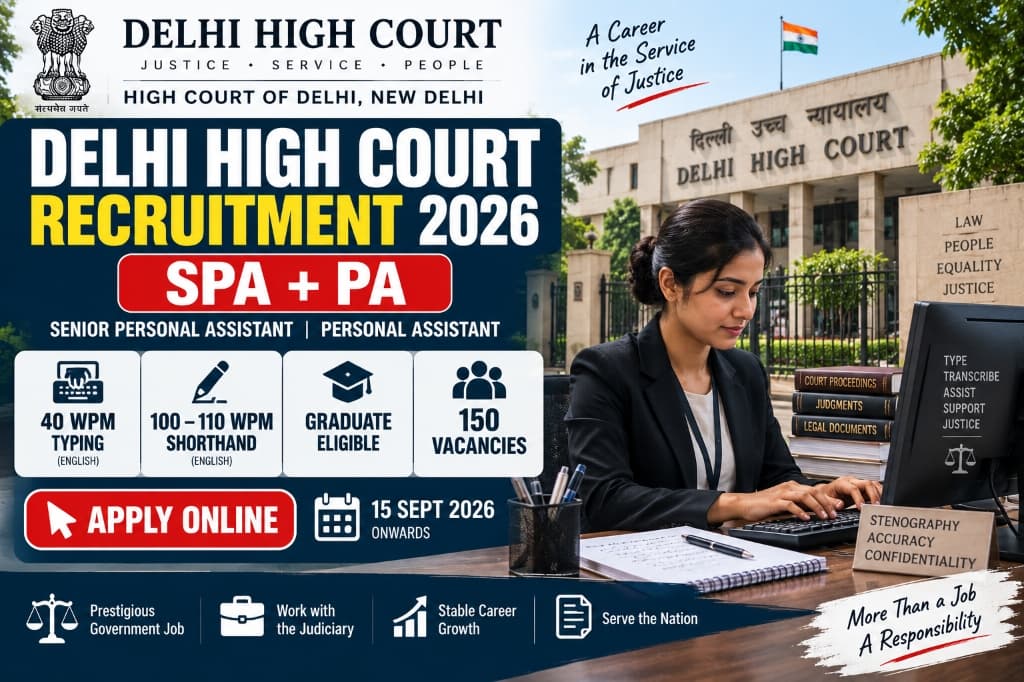
Delhi High Court Recruitment 2026: Senior Personal Assistant and Personal Assistant Vacancies, Typing Test, Shorthand, Eligibility, Salary and How to Apply
Complete guide to Delhi High Court SPA & PA Recruitment 2026 for 150 vacancies. Check 40 WPM English typing test rules, 100/110 WPM shorthand criteria, Level 7/8 pay matrix, syllabus, and application process.

Khunti Forest Division Recruitment 2026: Walk-in Interview for 5 Posts, ₹30,000 Salary, Eligibility and How to Apply
Complete guide to Khunti Forest Division Jharkhand Recruitment 2026 for Team Leader, RS-GIS Expert, Statistician, and Field Data Collector posts. ₹30,000 monthly salary, walk-in interview details, eligibility, and application procedure.
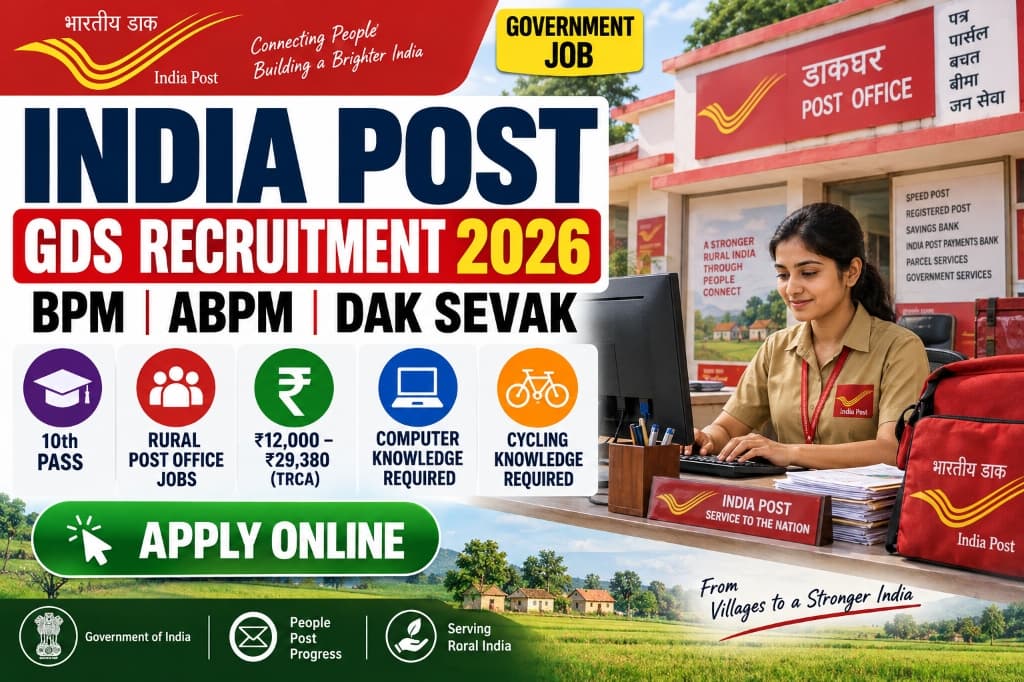
India Post GDS Recruitment 2026: BPM, ABPM and Dak Sevak Eligibility, Salary, Selection Process and How to Apply
Complete guide to India Post Gramin Dak Sevak (GDS) Recruitment 2026 Schedule-II for 10th pass candidates. Check BPM, ABPM, Dak Sevak salary, computer knowledge criteria, merit list, and application procedure.
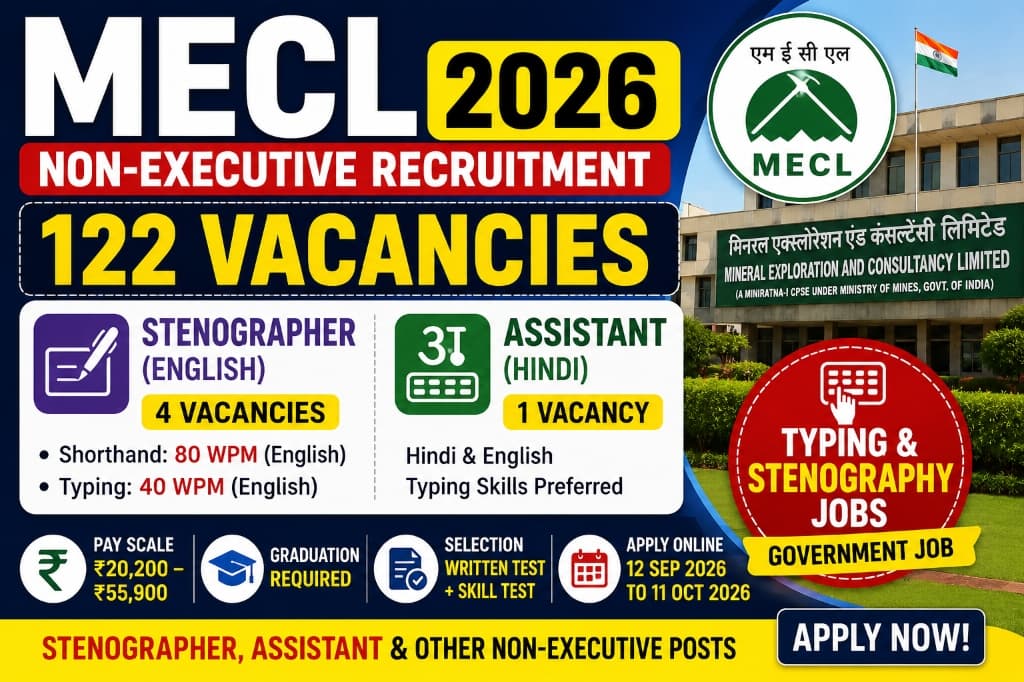
MECL Non-Executive Recruitment 2026: Stenographer, Assistant and Typing Jobs, 122 Vacancies, Eligibility, Salary and Selection Process
Complete guide to MECL Non-Executive Recruitment 2026 for 122 vacancies including Stenographer (English 40 WPM typing & 80 WPM shorthand), Assistant (Hindi), eligibility, and salary.