
10 Most Common Mistakes in Hindi Typing and How to Fix Them (InScript + Remington Gail Guide)
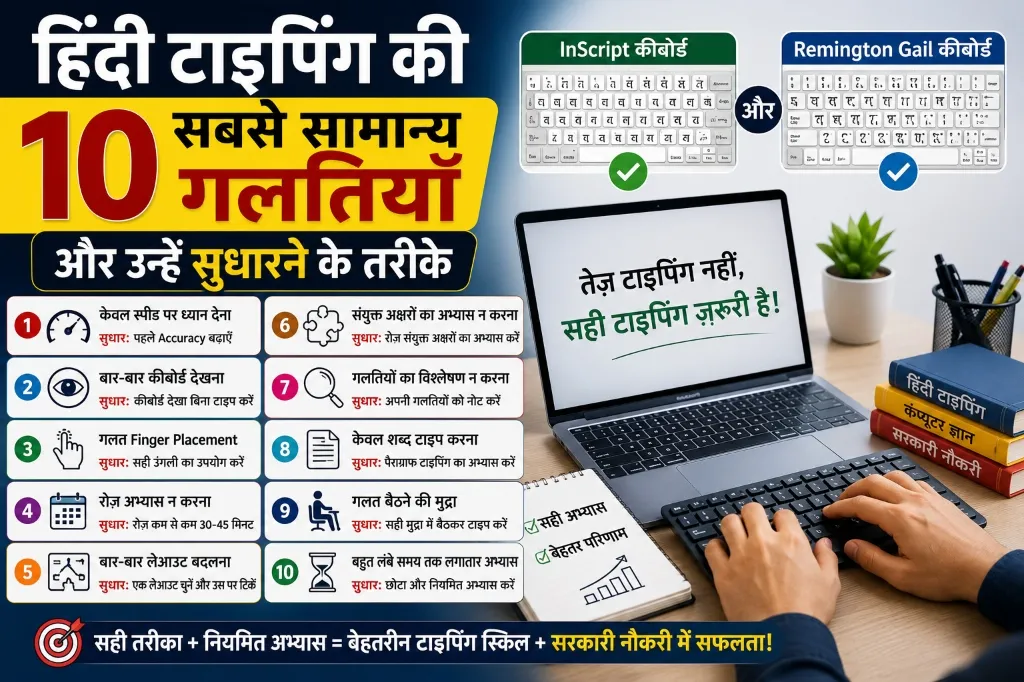
If you are preparing for a government job and learning Hindi typing, simply increasing speed is not enough. The biggest problem for most candidates is not that their typing is slow, but that they repeatedly make mistakes that affect their Accuracy, Speed, and Typing Test performance.
Whether you are learning the InScript keyboard or Remington Gail, almost every beginner candidate makes some common mistakes. The good news is that by identifying these mistakes and correctly fixing them, you can bring remarkable improvement to your typing in just a few weeks.
In this detailed article, we will learn deeply about the 10 most common mistakes in Hindi typing, their causes, and practical ways to fix them.
---
# Why is it Important to Identify Mistakes?
Many candidates practice daily, but their speed does not increase for a long time.
The biggest reason for this is that they practice incorrectly.
If you repeat the same mistake every day, your brain learns that exact wrong pattern. Therefore, improvement starts with recognizing your mistakes.
---
# Mistake 1: Focusing Only on Speed
This is the most common mistake.
Many candidates want to type fast from the very first day.
The result—
* Mistakes increase. * Accuracy decreases. * Bad habits are formed.
How to fix it?
First, focus on Accuracy.
Only attempt to increase speed after achieving 95–98% Accuracy.
---
# Mistake 2: Looking at the Keyboard Repeatedly
If you look at the keyboard while typing every word, your muscle memory will not develop.
In a government typing test, this habit can slow down your performance.
How to fix it?
* Keep your focus on the screen. * Type slowly in the beginning. * Gradually reduce the habit of looking at the keyboard.
---
# Mistake 3: Wrong Finger Placement
The use of correct fingers is very important in both InScript and Remington Gail.
If you press every key with a different finger, your speed will not permanently increase.
How to fix it?
* Practice the home row position. * Use the designated finger for each key. * Practice slowly but correctly in the beginning.
---
# Mistake 4: Not Practicing Daily
Many candidates start practicing only when the exam approaches.
This is the biggest mistake.
How to fix it?
Practice for at least 30–45 minutes daily.
Muscle memory is developed only through regular practice.
---
# Mistake 5: Changing Keyboard Layout Repeatedly
InScript for a few days, then Remington Gail, then Phonetic…
This confuses the brain.
How to fix it?
Choose a layout according to the recruitment you are preparing for, and practice continuously on that one. See our How to Set Up Hindi InScript Keyboard on Windows 10/11 and macOS guide to set up the keyboard layout on your system.
---
# Mistake 6: Not Practicing Conjunct Characters
The most time spent in Hindi typing is often on conjunct characters (sanyukt akshar).
For example—
* क्ष * त्र * ज्ञ * श्र * स्त * प्र
If you don't practice these, you will pause repeatedly during paragraph typing.
How to fix it?
Practice conjunct characters and difficult words exclusively for 10–15 minutes daily.
---
# Mistake 7: Not Analyzing Mistakes
Most candidates take speed tests but do not check where the mistake happened.
How to fix it?
Write down after every test—
* Which letter got wrong repeatedly? * Which matra (modifier) caused an issue? * Which word felt the hardest?
Work on these exact weaknesses in your next practice session.
---
# Mistake 8: Not Practicing Actual Paragraphs
Some candidates keep typing only letters or words.
But usually, in the exam, you have to type a paragraph.
How to fix it?
Every day type—
* News * Government Notices * Articles * General Hindi paragraphs
This will provide preparation like the actual exam.
---
# Mistake 9: Incorrect Sitting Posture
Typing is not just the work of hands.
If your posture is wrong, fatigue sets in quickly and speed is also affected.
Correct Posture
* Keep your back straight. * Keep both feet on the floor. * The monitor should be in front of your eyes. * Keep your shoulders relaxed. * Do not put too much pressure on your wrists.
---
# Mistake 10: Practicing Continuously for Too Long
Some candidates practice for 3–4 hours in a single day and then do not practice for several days.
This is not an effective method.
How to fix it?
Practice for 30–45 minutes daily.
Short but regular practice sessions are the best.
---
# Special Tips for Those Learning InScript and Remington Gail
If you are learning InScript
* Memorize the positions of vowels and consonants well. * Practice more on the home row. * Practice the Shift keys as well.
---
If you are learning Remington Gail
* Do not change the layout repeatedly. * Make a list of difficult letters and practice them. * Take regular speed tests according to the government exam.
---
# Extra Tips for Government Job Aspirants
If your goal is a government job like—
* Court Recruitment * Secretariat * Clerk * Typist * Stenographer * Data Entry
Then give as much importance to typing as the written exam. For specific tips on the stenographer skill test, also check out our SSC Stenographer Skill Test: How to Succeed in Hindi Dictation and Typing guide.
---
# How to Track Your Mistakes?
Maintain a practice diary.
Write down every day—
* Total Time * WPM * Accuracy * Hardest Words * Most Incorrectly Typed Letters
Compare every week.
This will show clear improvement.
---
# 30-Day Improvement Plan
Week 1
* Accuracy * Finger Placement * Keyboard Layout
---
Week 2
* Conjunct Characters * Words * Matras (Modifiers)
---
Week 3
* Paragraph Typing * Mock Test * Mistake Analysis
---
Week 4
* Practice mimicking the real exam * Speed + Accuracy balance * Time Management
---
# Why is Muscle Memory Important?
If you practice correctly every day, your fingers gradually memorize the key positions.
This is Muscle Memory. To thoroughly understand the scientific principles behind it, you can read our Muscle Memory: The Scientific Way to Learn Fast Typing guide.
Its benefits—
* Speed increases. * Mistakes decrease. * Confidence increases. * Exam nervousness is reduced.
---
# Is it Enough to Just Take Speed Tests?
No.
A speed test only tells your current status.
Improvement happens when you—
* Analyze your mistakes. * Work on your weaknesses. * Practice regularly. Check your progress daily by taking a speed test on TypeHindi.in.
---
# Frequently Asked Questions (FAQ)
Should I increase speed or Accuracy first?
Always prioritize Accuracy. Speed naturally increases after typing correctly.
---
Is it necessary to practice every day?
Yes. Regular practice is essential for muscle memory and stable speed.
---
Should I learn both InScript and Remington Gail?
If a specific layout is prescribed for a particular recruitment, focus on that one. Changing the layout repeatedly without necessity is not appropriate.
---
Is it wrong to type by looking at the keyboard?
It's normal in the beginning, but learning touch typing is much more beneficial in the long run.
---
What is the biggest mistake?
Chasing after speed and ignoring Accuracy.
---
# Conclusion
The secret to becoming fast and accurate in Hindi typing is not just practicing more, but practicing correctly. Most candidates repeat the same mistakes over and over—like focusing only on speed, constantly looking at the keyboard, adopting wrong Finger Placement, or failing to analyze their weaknesses. If you correct these common mistakes in time, you will see a rapid improvement in both your typing speed and Accuracy.
If your goal is a government job, do not consider typing as just an extra skill, but make it an important part of your preparation. Choose the right keyboard layout, practice regularly every day, record your progress, and try to correct your mistakes every week. This habit is what will help you perform better in the typing test and get ahead in the competition.