
SSC Stenographer Skill Test: How to Succeed in Hindi Dictation and Typing? (Complete Success Strategy)
The Stenographer Grade 'C' and 'D' exam conducted by the Staff Selection Commission (SSC) is an excellent opportunity for candidates aiming to build a prestigious administrative career in various ministries and departments of the central government.
The most challenging and decisive stage of this exam is the—Stenography Skill Test.
No matter how good your marks are in the written exam, if you cannot clear the skill test, all your hard work is in vain. Particularly for Hindi medium candidates, writing dictation and then transcribing (translating) it accurately on a computer is a major challenge.
In this detailed article, we will extensively discuss the entire process of the SSC Stenographer Skill Test, criteria for Grade C and D, scientific techniques for writing dictation, computer typing rules, formulas for mistake evaluation, and practical strategies to pass it.
---
# SSC Stenographer Skill Test: Basic Structure of the Exam
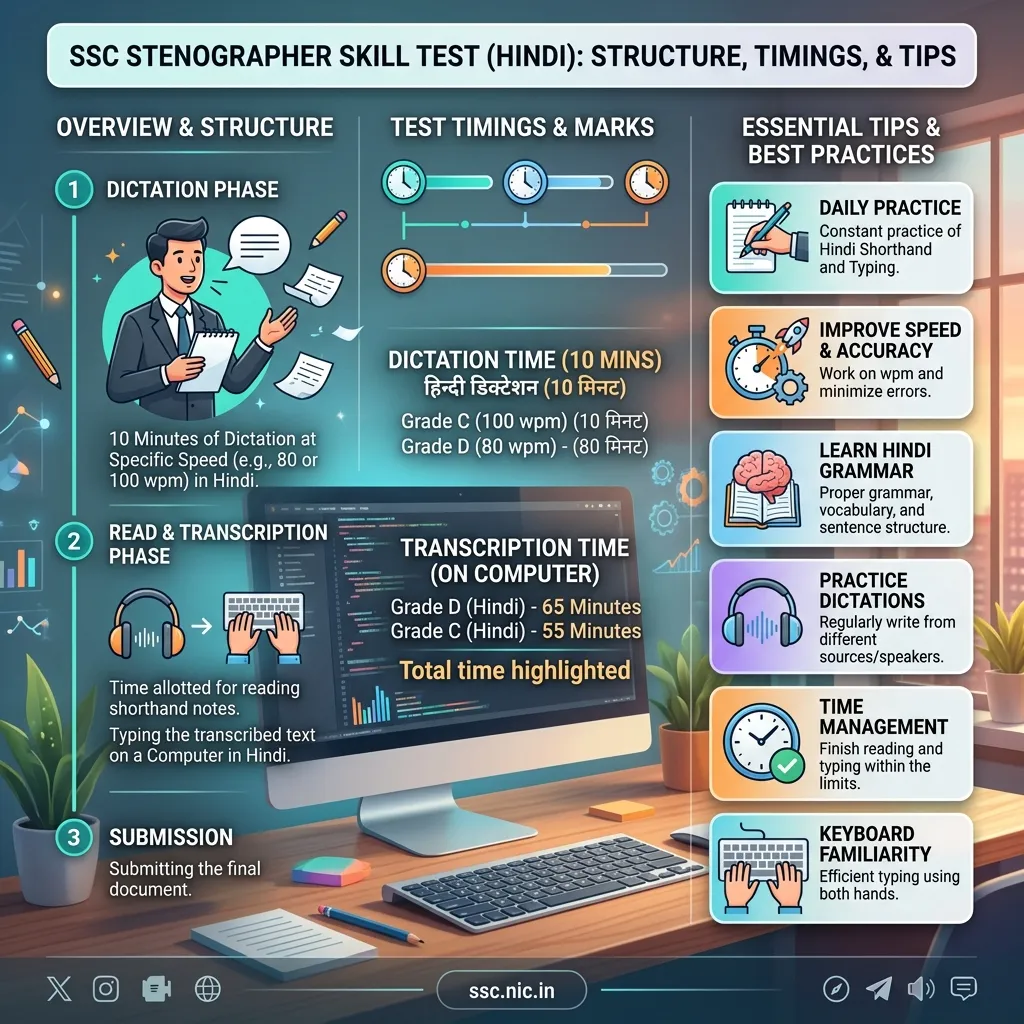
The SSC Stenographer skill test is divided into two parts:
Grade-wise Criteria and Time Limits:
Stenographer Grade 'C' - Hindi:
* Dictation Speed: 100 Words Per Minute (WPM) * Dictation Duration: 10 minutes (Total 1000 words) * Transcription Time (Computer Typing): 55 minutesStenographer Grade 'D' - Hindi:
* Dictation Speed: 80 Words Per Minute (WPM) * Dictation Duration: 10 minutes (Total 800 words) * Transcription Time (Computer Typing): 65 minutes---
# Key Subjects and Vocabulary of Dictation (Dictation Topics)
The dictation topics in the SSC exam are generally not fictional. The material is sourced from:
* Parliamentary Debates: Statements delivered by ministers and MPs in the Lok Sabha and Rajya Sabha. * Presidential/Prime Ministerial Addresses: Government policies and announcements on various national and international platforms. * Budget Proposals and Plan Reports: Documents issued by the Ministry of Finance and NITI Aayog. * Editorials: Editorial pages of reputed national-level Hindi newspapers (like Dainik Jagran, Jansatta, Navbharat Times).
Importance of Administrative Vocabulary:
Administrative words like *constitutional (samvaidhanik), legislative (vidheey), administrative (prashasanik), jurisdiction (kshetradhikar), implementation (kriyanvayan), remarkable (ullekhniya), self-reliance (aatmanirbharta), strengthening (sudridhikaran)* etc. appear frequently in dictation. If you do not practice these words beforehand, your pen/pencil will halt during the dictation and you will miss many words.---
# Scientific Techniques for Writing Shorthand
1. Pencil or Pen: Which to Use?
* Pencil: For beginner and intermediate stenographers, a pencil (such as Apsara or Steadtler steno-specific pencils) is the best. It slips less on pages and helps in making thick/thin strokes based on pressure. * Pen: If your speed is 100+ WPM and your fingers work with a very light touch, you can use a steno-specific pen.2. Don't Worry About 'Missed Words'
During dictation, if an outline goes wrong or a word gets missed, do not waste time thinking about it. Leave that word immediately and focus on writing the next words. If you chase a missed word, you will miss the next 4-5 words as well.3. Clarity of Outlines
Do not make your outlines very messy or illegible in a rush for speed. Remember that you have to read those outlines yourself later. If you cannot decipher your own handwriting, you will have to guess while typing, which increases errors.4. Proper Use of the 10-Minute 'Reading Time'
After the dictation ends and before computer transcription begins, the commission provides candidates a 10-minute reading time. Use this time to: * Quickly read your shorthand notes from start to finish. * Use a pencil to correct or identify outlines you find difficult to read. * Mentally understand the grammar of sentences to avoid vowel/spelling mistakes while typing.---
# Computer Transcription (Typing) and Keyboard Rules
Transcribing refers to typing on the computer by looking at the shorthand pad. There are some strict rules for this:
* Acceptable Keyboard Layout (Hindi): Unicode-based Mangal Font on InScript or Remington Gail. If you are completely new, learn InScript because it is scientific. To set up the keyboard layout, see our InScript Setup Guide. * Permission to use Backspace: In the SSC exam, there is full permission to press backspace during transcription. You can correct mistyped words. However, excessive use of backspace wastes time, so focus on accuracy. Refer to our 10 Most Common Mistakes in Hindi Typing guide to minimize errors. * Time Management: * The time provided for Grade D (65 minutes) and Grade C (55 minutes) is ample. * You should type out the entire paragraph in the first 35-40 minutes. * The final 15 minutes should be used exclusively for proofreading and fixing missed letters.
---
# Rules for Mistake Evaluation
Mistakes in the SSC Stenographer exam are calculated in a very detailed manner:
Full Mistakes:
* Omitting a word entirely. * Adding an extra word not present in the paragraph. * Typing another word instead of the correct one. * Major spelling and vowel sign errors in Hindi.Half Mistakes:
* Failing to change the paragraph or doing it at an improper place. * Spacing errors between words. * Minor errors related to nasal sounds (chandrabindu or anuswar). * Punctuation errors (like full stops, commas).Permissible Error Limits:
Generally, an error limit is set for different categories: * Grade 'C': Up to 5% mistakes allowed for the General category and 7% for reserved categories. * Grade 'D': Up to 7% mistakes allowed for the General category and 10% for reserved categories.---
# Daily Practice Plan for Success
---
# Frequently Asked Questions (FAQ)
Is dictation played on an audio player in the exam hall or does a person speak it?
Nowadays, in SSC exams, a pre-recorded audio is played over speakers so that all candidates get uniform voice and clarity.Can I bring my own shorthand pad and pencil to the exam center?
No. The commission provides shorthand pads (notebooks) and pencils/pens right in the exam hall. You are not allowed to bring your own writing instruments.Which keyboard layout is the best for Hindi stenography?
The Unicode-based InScript keyboard is the most scientific and secure. However, if you have learned KrutiDev before, you can type in Mangal font on Remington Gail too. For more information, see our InScript vs Remington Keyboard Guide.What to do if a line is missed during dictation?
Leave it instantly without panicking and resume writing from where the dictator is currently speaking. Do not ruin the entire dictation for the sake of one missed line.---
# Conclusion
There is no shortcut to achieving success in the SSC Stenographer Skill Test. It entirely depends on your consistency, focus, and scientific practice. Practice outlines for difficult administrative words daily, listen carefully to dictations, and prioritize accuracy during computer transcription. With the right strategy and strong determination, you can easily clear this skill test and get selected as a Stenographer in the central government.