
Why Has the Importance of Stenography Not Decreased Even in the Digital Age? (Complete Guide)
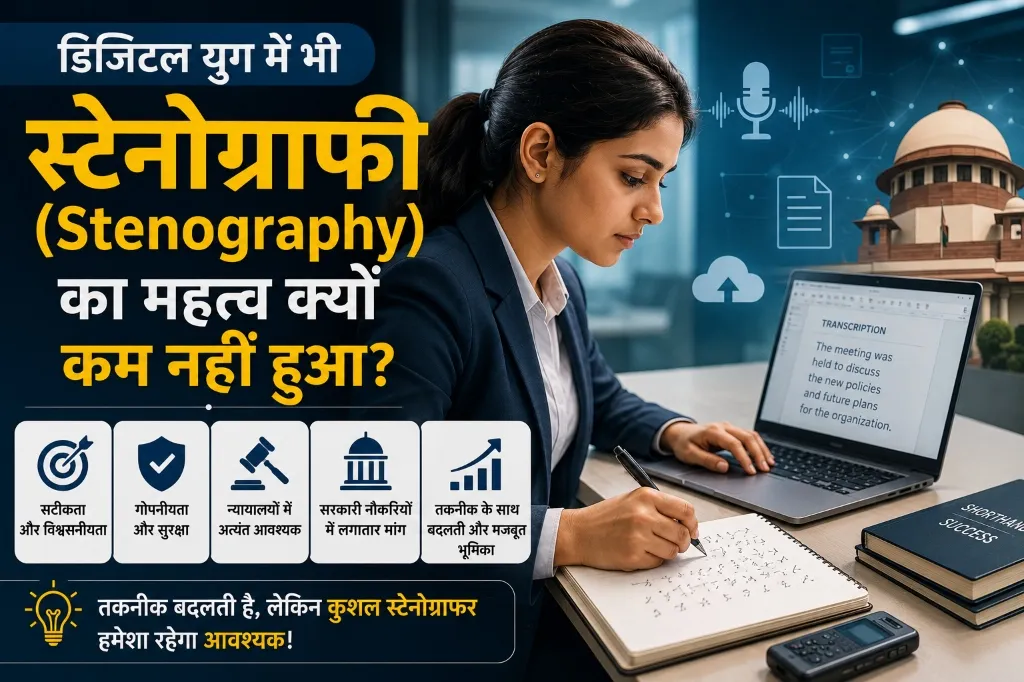
Today is the era of artificial intelligence (AI), speech-to-text, automatic transcription, and digital recording. Smartphones can convert voice to text in seconds, online meetings are automatically recorded, and modern software can prepare long documents in minutes.
In such a scenario, a common question arises in the minds of many people—is stenography still relevant? Has its need ended in the digital age?
The answer is—No.
Despite the rapid advancement of technology, the importance of stenography remains intact today. Trained stenographers are still needed in courts, government departments, ministries, legislative assemblies, parliament, the judiciary, media, and many private institutions. In reality, technology has changed the way stenographers work, but it hasn't eliminated the value of their skills.
In this article, we will explore in detail why stenography is important even in the digital age, what its future holds, what the career prospects are, and why beginners should learn it.
---
# What is Stenography?
Stenography is a writing technique in which spoken words are written with the help of special symbols (Shorthand Symbols) at a much higher speed than normal writing.
Later, these same symbols are typed in standard language.
For this reason, stenography is used in places where it is necessary to keep an accurate record of every word spoken.
---
# Why Was Stenography Challenged in the Digital Age?
Over the past few years, many new technologies have evolved—
* Speech-to-Text Software * AI-based Transcription * Voice Recognition * Digital Recording * Online Meeting Platforms * Automatic Captions
Due to these technologies, it seemed that the need for stenographers would decrease in the future.
But the reality is different.
---
# Why is Stenography Important Despite Technology?
1. Requirement of 100% Accuracy
AI-based transcription often misidentifies—
* Names * Technical terms * Legal terms * Pronunciations * Regional languages
On the other hand, a trained stenographer can prepare a much more accurate record by understanding the context.
---
2. Reliable Records in Courts
Every word can have legal significance in courts.
Therefore, merely audio recordings are not sufficient.
Human verification and accurate writing are still necessary today.
---
3. Usage in Confidential Meetings
Many government meetings involve discussions on topics like—
* Defense * Security * Policy-making * Sensitive administrative matters
In such situations, trained stenographers play a crucial role in preparing reliable documents.
---
4. Technology is Not Always Perfect
AI-based systems can face issues with—
* Noise * Multiple people speaking simultaneously * Weak internet * Different accents * Local dialects
In such situations, a human stenographer can prove to be much more effective.
---
# Importance of Stenography in Government Jobs
Many government departments in India still recruit stenographers.
Examples—
* Ministries * Courts * Parliament * State Secretariats * Commissions * Government Offices
Both shorthand and typing skills are required in these institutions.
---
# Why is the SSC Stenographer Exam Popular?
The SSC Stenographer exam is one of the popular exams for candidates wanting to build a career in computer-based work and administrative services. If you are preparing for this exam, be sure to read our SSC Stenographer Skill Test Strategy, which contains the fundamental principles for success in Hindi dictation and transcription.
In this exam, the candidate's—
* Shorthand Speed * Transcription Ability * Typing Skill
are evaluated.
---
# Can AI Replace Stenographers?
Currently, the answer is absolutely not.
AI can speed up many tasks, but—
* Understanding context * Legal language * Confidential information * Final editing * Factual verification
In such tasks, the role of a human expert is still vital.
In the future, AI could become an assisting tool, but it is not a complete replacement for a stenographer in every situation.
---
# What Digital Tools Do Stenographers Use Today?
Today's stenographers are not limited to just a notebook and pen.
They use many modern tools—
* Computers * Digital Recorders * Transcription Software * Headphones * Speed Typing Software * Document Editors * Cloud Storage
Hence, modern stenography is a mix of both traditional and digital skills.
---
# Major Benefits of Learning Stenography
1. Government Job Opportunities
Candidates who know shorthand can become eligible for many competitive exams.
---
2. Better Typing Speed
Most students who learn stenography gradually become excellent typists as well. To understand the scientific technique for increasing typing speed, you can check out our Muscle Memory: The Scientific Way to Learn Fast Typing guide.
---
3. A Specialized Skill
Not every candidate knows shorthand.
So, this gives you a distinct identity in the competition.
---
4. Ability to Take Fast Notes
It becomes easy to write notes rapidly during meetings, lectures, or interviews.
---
5. Improvement in Language Skills
Constant listening, comprehending, and writing strengthen the grip on the language.
---
# Should Beginners Learn Stenography?
If your goal is to build a career in—
* SSC Stenographer * Government Jobs * Court Work * Secretarial Services * Administrative Offices
Then learning stenography can be a great decision.
---
# How Long Does It Take to Learn Stenography?
This depends on practice.
If you practice regularly every day, generally—
* First 2 months — Fundamentals of shorthand * 3–6 months — Improvement in speed * 6–12 months — Good speed and transcription ability
can be developed.
---
# Is Learning Just Shorthand Enough?
No.
Today's stenographer should also learn the following skills—
* Computer Operations * Hindi or English Typing * MS Word * Document Formatting * Email Writing * Digital File Management
For fast computer typing, learning and practicing the InScript Keyboard Layout is the most scientific and useful method.
---
# What Will Happen to Stenography in the Future?
The likelihood is that the role of stenographers will not end, but will evolve with changing technology.
The stenographer of the future—
* Will use AI Tools. * Will edit digital transcriptions. * Will verify recordings. * Will be proficient in both fast typing and shorthand.
In other words, technology will become a collaborator, not a competitor.
---
# How to Start Learning Stenography?
If you are an absolute beginner—
---
# Useful Tips for Beginners
* Practice for at least 30–60 minutes daily. * Focus on accuracy before speed. * Learn both shorthand and typing together. * Listen to regular dictations. * Track your progress every week by taking tests on TypeHindi.in.
---
# Common Myths About Stenography
Myth 1
"Stenography will end after the arrival of AI."
Truth—
AI can assist in many tasks, but human experts are still required in multiple fields.
---
Myth 2
"Stenography is only for courts."
Truth—
Government offices, ministries, private companies, media, and other institutions also use stenography skills.
---
Myth 3
"Learning stenography is very difficult."
Truth—
Anyone can learn it with regular practice and proper guidance.
---
# Frequently Asked Questions (FAQ)
Is the future of stenography secure in the digital age?
Yes. Despite technological advancements, trained stenographers remain in demand across many sectors.
---
Can AI completely replace stenographers?
Currently, no. Especially in legal, administrative, and sensitive tasks, human experts are still crucial.
---
Should typing be learned along with stenography?
Yes. Fast typing is an essential skill for modern stenographers.
---
Is regular practice necessary for SSC Stenographer?
Absolutely. Regular practice in both shorthand and transcription is the key to success.
---
Is learning stenography still beneficial today?
If your goal is a government job, secretarial services, or professional transcription, it is still a valuable skill today.
---
# Conclusion
Despite the rapid development of digital technology, artificial intelligence, and automatic transcription, the importance of stenography has not diminished. In fact, its role has become more modern today. Where technology helps in recording and preliminary transcription, trained stenographers ensure accuracy, understanding of context, confidentiality, and the quality of the final document. This is why stenography is still considered an important skill in the judiciary, government departments, and administrative institutions.
If you are a beginner and want to build a career in the administrative or government sector, learning stenography can prove to be a long-term investment. With regular practice, good typing speed, and knowledge of modern digital tools, you can prepare yourself for the changing work styles of the future. Technology will keep changing, but the need to record fast, accurate, and reliable information will always remain—and this is the greatest strength of stenography.